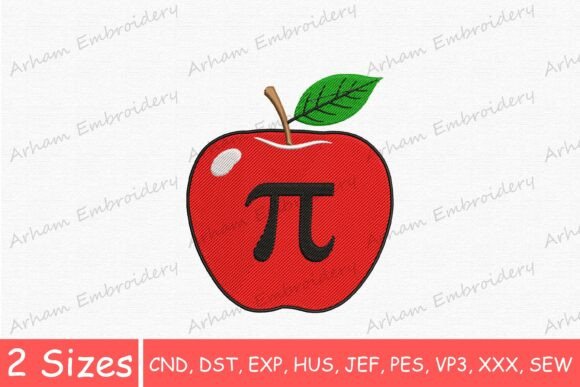
Red Apple with Pi Embroidery: A Business Review
First Impressions for Commercial Merchandise
As an embroidery designer evaluating assets for small business merchandise, my first impression of the Red Apple with Pi Embroidery is that it strikes a necessary balance between academic professionalism and approachable warmth. For businesses in the education sector, tutoring centers, or STEM-focused boutiques, visual identity must communicate intelligence without feeling sterile. This design achieves that by pairing the universal symbol of teaching—the apple—with the specific intellectual marker of the Pi symbol. It does not read as juvenile clip art; rather, it presents as a deliberate brand identity marker suitable for staff uniforms and client-facing goods.
The aesthetic leans towards classic and trustworthy, which is vital for service-based businesses where credibility is the product. When reviewing this machine embroidery design, I look for clean lines and distinct separation between elements. The integration of the mathematical symbol within or beside the fruit shape suggests a unified logo treatment rather than two disparate icons forced together. This cohesion is essential for small business merch because it ensures the design remains legible and impactful even when scaled down for chest logos or sleeve accents.
Real-World Applications for Shops and Studios
In a real case scenario, imagine a private tutoring center or an educational supply boutique looking to elevate their custom apparel. The Red Apple with Pi Embroidery serves as an excellent primary logo for polo shirts or a secondary badge for apron embroidery in a classroom setting. For a bakery or café located near a university campus, this design could function as a seasonal or niche promotional item on tote bags, signaling to students and faculty that the business aligns with their community values.
- Staff Uniforms: Placed on the left chest of polos or button-downs, the design acts as a professional identifier that fosters team unity and customer trust.
- Tote Bag Design: As a larger imprint on canvas shoppers, the red and white thread colors provide high contrast and visibility, turning customers into walking advertisements.
- Embroidered Patch: Producing this as a standalone merrowed-edge patch allows for versatile application on denim jackets, backpacks, or caps without committing to direct embroidery on inventory.
- Cap Embroidery: The compact nature of an apple shape fits well within the limited vertical space of a hat front, provided the Pi symbol maintains adequate spacing.
For Etsy sellers or makers creating handmade product lines for teachers, this digital embroidery file offers a quick route to personalized gifts. However, for commercial use, the value lies in its ability to transform generic blanks into branded assets. Whether applied to a work shirt or used as a packaging accent on tissue paper seals, the design reinforces the niche expertise of the business.
Technical Considerations and Production Limits
While the concept is strong, technical execution determines whether the finished product looks premium or amateur. When using this embroidery file for business merchandise, you must evaluate stitch density relative to your chosen substrate. Apples often involve fill stitches that can become dense; if placed on a lightweight performance shirt or a loosely woven tote, this density may cause puckering or fabric distortion. Always test the design on the actual material intended for production.
Small sizing is another critical constraint. If you intend to use the Red Apple with Pi Embroidery as a tiny label or cuff detail, verify that the Pi symbol retains its definition. Mathematical symbols have thin strokes and curves that can disappear or bleed into surrounding fills if reduced below a certain threshold. I recommend avoiding sizes smaller than 2 inches wide unless the file has been specifically digitized for micro-detail. On textured fabrics like pique knits or terry cloth, fine details of the Pi may get lost, requiring a heavier underlay or a slight size increase.
Color contrast is equally important. The classic red apple relies on contrast against the background fabric. On dark uniforms, ensure the outline or border of the apple is distinct so the shape doesn't vanish into a navy or black shirt. For cap embroidery, consider the curvature of the hat; flat designs can distort on curved surfaces, so running a test sew-out on a cap blank is mandatory before bulk production.
Strengthening Brand Identity Through Stitch
Embroidery adds tangible value to merchandise that print cannot replicate. Using the Red Apple with Pi Embroidery signals a commitment to quality and permanence. For a tutoring business or educational brand, this tactile element subconsciously communicates stability and attention to detail—traits clients seek in educators. Consistency across different items builds recognition; seeing the same stitched motif on a receptionist’s polo, a giveaway tote, and a thank-you card creates a cohesive visual language.
Furthermore, this design supports buyer engagement through relatability. In the School category, emotional connection drives sales and loyalty. A well-executed stitch pattern feels personal and crafted, distinguishing a local business from mass-produced corporate entities. When customers receive a gift or purchase merch featuring this embroidered patch, they perceive higher value, which justifies premium pricing for services or products associated with the brand.
Designer Notes for Successful Implementation
Before loading this machine embroidery design into your machine for a commercial run, adhere to these professional best practices to protect your business reputation and minimize waste:
- Verify Licensing: Confirm the commercial embroidery rights included with the file. Ensure you are permitted to sell finished products or use the design for internal business branding, as terms vary by digitizer.
- Check File Specifications: Review the included documentation for exact stitch count, recommended hoop size, and color sequence. Do not assume compatibility with your machine format without verification.
- Run Black and White Tests: Print a line drawing or sew a single-color test to check spacing and registration before committing to multi-color thread changes. This reveals alignment issues early.
- Select Proper Stabilizer: Match your backing to the fabric weight. Use cut-away for stretchy knits and tear-away for stable wovens. Incorrect stabilization is the most common cause of poor results in apron embroidery and apparel.
- Create Printable Mockups: Before stitching physical samples for client approval, generate digital mockups to confirm placement and scale. This saves time and materials during the design approval phase.
- Audit Thread Colors: Compare the specified thread colors against your physical stock. Screen colors in software often differ from rayon or polyester sheen. Choose threads that maintain sufficient contrast for readability.
- Compare Beside Other Assets: Place this design next to your existing text logos or icons. Ensure the style, weight, and vibe are consistent to maintain a unified brand identity.
By treating the Red Apple with Pi Embroidery as a strategic business asset rather than just a decorative craft file, you leverage its full potential. Proper testing, mindful application, and respect for technical limits will ensure this design serves your merchandise program effectively, enhancing both professional appearance and customer connection.